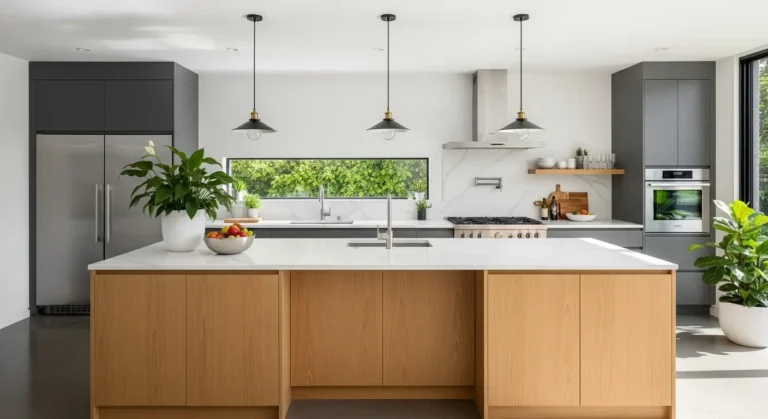

When it comes to selecting a kitchen countertop, “durability” is usually the first word out of a homeowner’s mouth.
We want a surface that can survive the chaos of a busy household—the sliding of heavy cast-iron pans, the accidental slip of a chef’s knife, and the constant clatter of grocery bags and appliances.
For decades, granite has been the gold standard for toughness. It is the literal definition of “rock solid.”
However, a new contender has entered the arena: large-format porcelain slabs. Often marketed as the ultimate high-tech surface, porcelain is challenging granite’s long-held reign.
But when we strip away the marketing and look at the raw data, how do they actually compare?
In this deep dive, we will analyze porcelain countertops vs granite hardness to see which material provides the most resilient surface for your home.
Understanding the Mohs Scale of Mineral Hardness
To compare these two materials scientifically, we have to use the Mohs Scale.
Developed in 1812 by German mineralogist Friedrich Mohs, this scale measures the scratch resistance of various minerals from 1 (talc) to 10 (diamond).
In the world of countertops, hardness is the primary defense against scratches. If a material is higher on the Mohs scale than the object rubbing against it, it will not scratch. If it is lower, it will.
- Granite typically ranks between 6 and 7 on the Mohs scale.
- Porcelain typically ranks between 7 and 8 on the Mohs scale.
On paper, porcelain is the harder material. But what does that actually mean for your kitchen? Let’s break down the composition and manufacturing of both to understand why these numbers differ.
Granite: The Natural Standard of Toughness
Granite is an igneous rock, formed deep within the earth’s crust from the slow crystallization of molten magma.
It is composed primarily of quartz, feldspar, and plagioclase, with bits of mica and other minerals thrown in for character.
Because it is a natural product, its hardness can vary depending on the specific quarry it came from.
A slab with a high quartz content will be closer to a 7, while a slab with more mica (a softer mineral) might have “soft spots” that rank closer to a 5.5 or 6.
The Strengths of Granite
Granite’s hardness makes it incredibly resistant to heat and daily wear. It is thick—usually 2cm or 3cm—which gives it a sense of “heft” and structural integrity.
Because it is a solid, natural block, it is less brittle than engineered materials, meaning it can absorb the impact of a dropped jar or a heavy pot relatively well.
Porcelain: The Engineered Powerhouse
Porcelain is not “stone” in the traditional sense, but it is made of stone-like minerals. It is composed of kaolin clay, feldspar, and silica.
These raw materials are pulverized into a fine powder, pressed under thousands of pounds of pressure, and then fired in a kiln at temperatures exceeding 2,500°F.
This process is called “vitrification.” It essentially turns the minerals into a glass-like, ultra-dense solid.
This man-made process allows for a level of density and uniformity that nature cannot always provide.
The Strengths of Porcelain
Because it is fired at such high temperatures and pressed so tightly, porcelain is incredibly dense.
This density is what pushes its hardness rating up to an 8. It is virtually impossible to scratch with a standard stainless steel kitchen knife (which usually ranks around a 5.5).
Porcelain Countertops vs Granite Hardness: The Direct Comparison
When we look specifically at porcelain countertops vs granite hardness, we are looking at a battle between natural geological force and modern industrial engineering.
1. Scratch Resistance
In a head-to-head scratch test, porcelain is the winner. While granite is very difficult to scratch, a particularly hard piece of unglazed ceramic or a specialized tool could potentially leave a mark.
Porcelain is so hard that it can actually act as a sharpening stone for your knives.
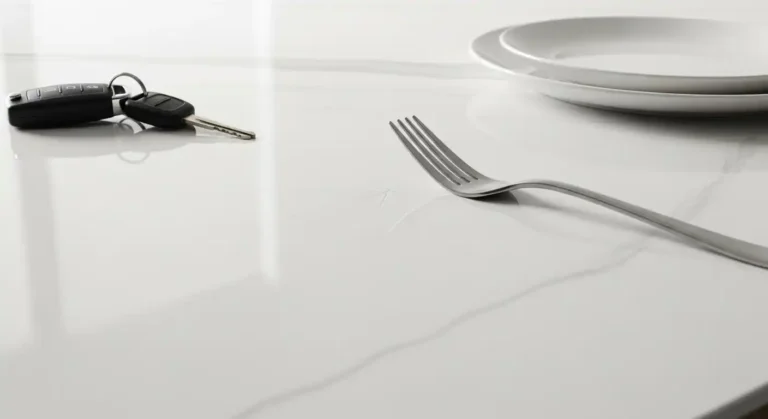
If you slide a knife across porcelain, you might see a grey mark—this isn’t a scratch, but “metal transfer,” where the porcelain has actually ground down a microscopic layer of the knife’s steel.
2. Impact Resistance (The Hardness Paradox)
This is where the comparison gets tricky. In materials science, there is a difference between “hardness” and “toughness.”
Hardness refers to scratch resistance, while toughness refers to the ability to resist fracturing or chipping.
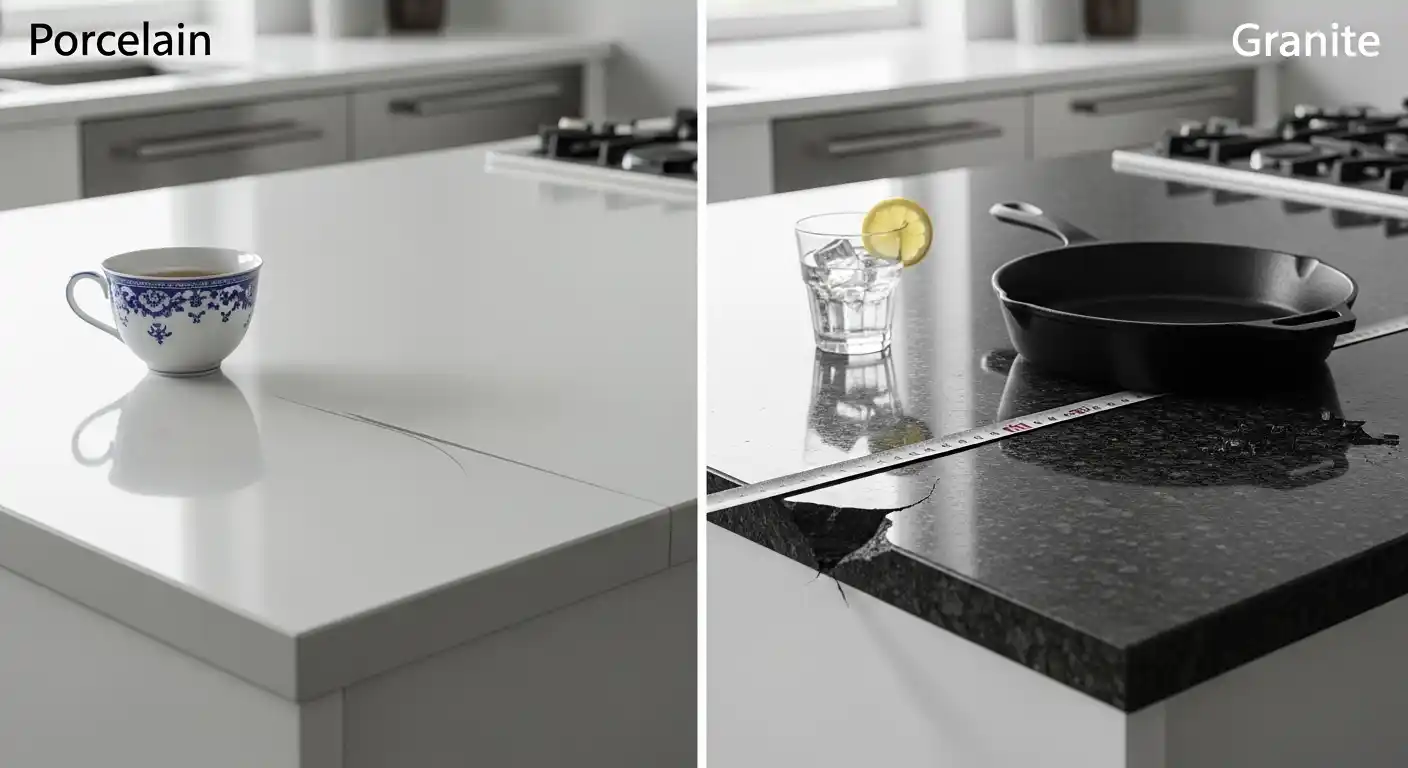
Because porcelain is harder and denser, it is also more brittle. Think of it like a diamond vs. a piece of high-quality steel.
A diamond is the hardest mineral on earth and cannot be scratched, but you can shatter it with a hammer. Steel is “softer” and can be scratched, but it won’t shatter.
Granite, being a bit “softer” and much thicker than porcelain slabs, is generally more impact-resistant.
If you drop a heavy cast-iron skillet on the edge of a granite counter, it might survive unscathed. If you do the same to a porcelain counter, the edge is much more likely to chip.
3. Uniformity
Granite is a “wild” material. It has veins, fissures, and mineral deposits that can create localized areas of weakness.
Porcelain is a “controlled” material. Its hardness is consistent from one corner of the slab to the other. You don’t have to worry about a “soft spot” in a porcelain counter.
Beyond Hardness: Other Factors to Consider
While hardness is vital, it isn’t the only factor that determines how a countertop survives in your home.
Porosity and Staining
Hardness doesn’t always equal stain resistance. Granite, despite its hardness, is porous.
It has tiny microscopic channels that can soak up liquids like red wine or oil if it isn’t sealed regularly.
Porcelain is vitrified and non-porous. Its “hardness” extends to its density, meaning it never needs to be sealed and is virtually stain-proof.
Heat Resistance
Both materials are champions of heat. Granite can handle hot pans, though extreme thermal shock (going from ice-cold to boiling hot) can occasionally cause a crack.
Porcelain is born in a kiln, making it essentially fireproof. It can handle the highest temperatures a kitchen can produce without any risk of damage.
Practical Implications for the Homeowner
How does the porcelain countertops vs granite hardness debate affect your daily life?
- If you are a “rough” cook: If you tend to bang pots around, have kids who might drop heavy objects, or want a countertop with a thick, rounded edge, granite’s “toughness” might be more beneficial than porcelain’s “hardness.”
- If you are a “clean” cook: If you want a surface that will never scratch, never stain, and never need to be sealed—and you are willing to be a little more careful with the edges—porcelain’s superior hardness and density make it the better choice.
Maintenance Differences
Because porcelain is harder and non-porous, its maintenance is significantly lower. You can use almost any cleaning agent on it, from vinegar to bleach, without worrying about “etching” or stripping a sealer.
Granite requires more specialized care; you must use pH-neutral cleaners and remember to re-seal the surface every year or two to maintain its protective barrier.
The Verdict: Which is Harder?
In the strict scientific sense of the word, porcelain is harder than granite. It ranks higher on the Mohs scale and offers superior resistance to scratching and surface wear.
It is a triumph of modern engineering that allows homeowners to have a surface that is nearly as hard as a gemstone.
However, granite remains the king of “ruggedness.” Its thickness and natural composition make it less prone to the chipping that can plague hard, brittle materials like porcelain.
Ultimately, the choice between porcelain countertops vs granite hardness depends on what kind of “tough” you need.
If you want a surface that stays looking brand-new and scratch-free for decades with zero maintenance, porcelain is the winner.
If you want a surface that can take a literal beating from heavy cookware without chipping, granite is still the heavyweight champion.
Regardless of which you choose, both materials represent the top tier of countertop durability, ensuring your kitchen remains beautiful and functional for a lifetime.