
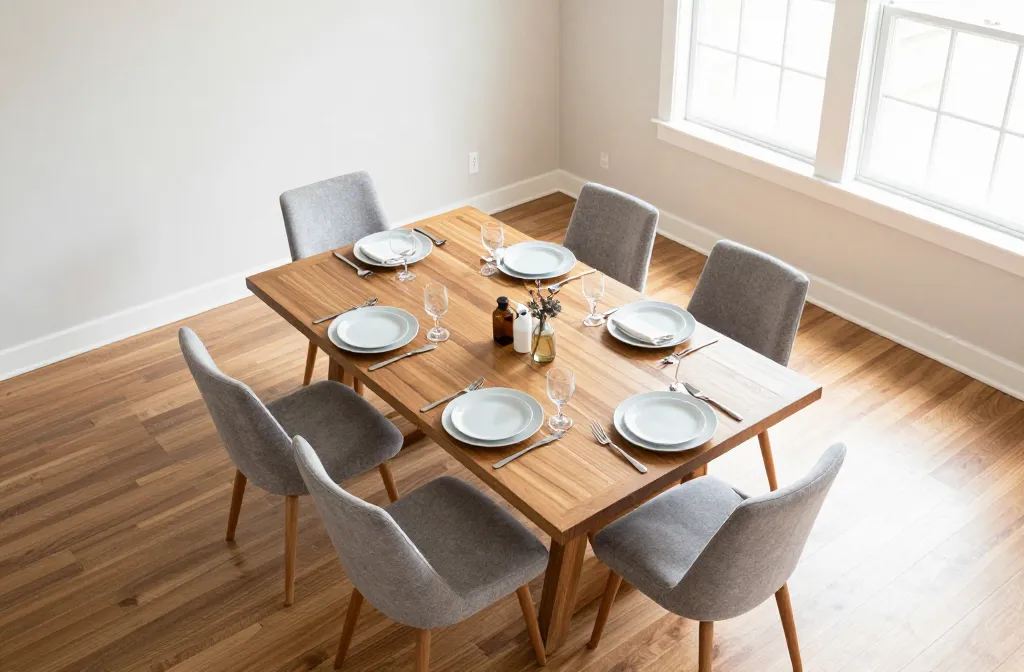
You need at least 36 inches (90 cm) of space between the dining table and the walls or furniture, so people can sit and move comfortably. For busier areas where people walk behind chairs, 48 inches (120 cm) is recommended to allow easy passing.

Ever walked sideways through your dining room because you squeezed in a table that’s just a bit too big?
Or maybe you’re staring at your floor plan right now, wondering if that gorgeous farmhouse table will actually fit without turning your dining space into an obstacle course.
Let’s talk about the goldilocks zone of dining room spacing—not too tight, not too spacious, but just right.
Why Dining Room Spacing Actually Matters
Look, you can have the most Instagram-worthy dining table in the world, but if people are bumping into walls trying to sit down, you’ve got a problem.
The relationship between your table and the walls around it can make or break the entire room’s vibe.
Here’s the thing: large chairs in a big room can actually make the space look smaller. Weird, right? And if you’re planning to add a sideboard or buffet, you need to factor that into your calculations too.
The width of your table matters just as much as the length—are we talking a slim 34-inch IKEA number, or are you going full Martha Stewart with a four-foot-wide table that can handle all those serving dishes?
The Magic Number: Three Feet Minimum
After real-world testing (and probably some furniture shuffling), the verdict is in: you need at least three feet (36 inches) from your table to the wall or any other furniture.
This is the bare minimum to comfortably pull out a chair and squeeze behind it without doing that awkward sideways shuffle.
Think about it. When someone sits down at your table, their chair extends backward. Then you or another guest needs to walk behind them to get to their own seat.
Three feet gives you just enough room to make that happen without everyone sucking in their stomach.
But minimum doesn’t mean ideal. It just means “technically functional.”
The Sweet Spot: Five to Six Feet
Want to know what actually feels comfortable? Five to six feet from table to wall is where the magic happens. At this distance, you can:
- Pull out chairs completely without hitting anything
- Walk comfortably behind seated guests
- Add a sideboard or buffet without creating a traffic jam
- Actually serve food without bumping into furniture
Real-world example: A dining setup with five feet on one side and about two feet on the other (with a sideboard taking up roughly 18 inches) works pretty well.
That two-foot side becomes functional when the sideboard is only 18 inches deep, leaving enough clearance to walk by.
Can You Go Bigger Than Six Feet?
Here’s where things get interesting. You’d think more space is always better, right? Not exactly. Six feet appears to be the maximum distance you should go from wall to table if you want the room to look proportionate.
Go beyond that, and your table starts looking lost in the space—like a sad island floating in the middle of nowhere. Even with chunky upholstered chairs, six feet should give you plenty of breathing room.
If you picture yellow floor tiles where each tile is one foot, and you’re looking at nine feet of space, it just looks… off. The proportions feel wrong.
Do the Math: Calculating Your Dining Room Size
Let’s get practical. Say you want six feet of space on each side of your table, and you’re eyeing a four-foot-wide table. Here’s the breakdown:
- 6 feet (wall to table) + 4 feet (table width) + 6 feet (table to opposite wall) = 16 feet total
That’s your ideal dining room width right there. If your room is smaller, you’ll need to adjust accordingly. Maybe you go with five feet on each side, which brings you down to 14 feet total.
FYI, this doesn’t account for super oversized upholstered chairs that can’t push up against the table.
If you’ve got those statement pieces with arms that stick out, you might need to measure from the back of the chair to the wall instead of from the table edge.
The Symmetry Secret Nobody Talks About
Here’s something that’ll save you from a decorating disaster: keep your dining room layout symmetrical, or your lighting will look totally off-center. Seriously.
If you shove a massive sideboard against one wall but leave the other side empty, your beautiful chandelier or pendant light is going to hang awkwardly to one side.
Your eye will pick up on that imbalance immediately, and it’ll bug you forever.
What If You Can’t Be Symmetrical?
Sometimes your room just won’t cooperate. Maybe there’s a doorway on one side, or your apartment layout is quirky (aren’t they all?).
In that case, create a new center point. Add alcoves or built-ins where your sideboards and buffets go, essentially creating defined zones.
This tricks the eye into seeing the furniture as part of the architecture rather than random pieces cluttering the space.
Table Width Matters More Than You Think
Not all tables are created equal, and width plays a huge role in how everything fits together.
A narrow 34-inch table leaves less room for dramatic centerpieces, but it also takes up less floor space. You can get away with less clearance on the sides.
A four-foot-wide table, on the other hand, is basically a serving station. You can pile on the dishes, add candlesticks, and still have room for plates.
But that extra width eats into your floor space quickly. Make sure you’re accounting for the actual dimensions of the table you want, not just an estimate.
Chair Size Can Make or Break Your Layout
IMO, chairs are the unsung heroes (or villains) of dining room design. Thin, streamlined chairs take up less visual and physical space.
Those big, cushy upholstered dining chairs with arms? They’re comfortable as heck, but they require way more clearance.
Before you fall in love with a set of chairs, measure them. Check how far they extend when pulled out. See if they can tuck under the table or if the arms prevent that.
These details will determine whether you can stick with that three-foot minimum or if you need to bump up to four or five feet.
Conclusion: Trust the Numbers, But Also Your Gut
At the end of the day, dining room spacing comes down to some tried-and-true measurements: three feet minimum, five to six feet for comfort, and six feet maximum to maintain good proportions.
Factor in your table width, chair size, and any additional furniture like sideboards.
But also? Walk through the space. Sit in the chairs.
Pretend you’re hosting Thanksgiving and need to squeeze past Aunt Carol to grab the potatoes. If it feels cramped in your imagination, it’ll definitely feel cramped in real life.
Trust the numbers as your starting point, but let your actual experience guide the final decision.
Frequently Asked Questions
What’s the absolute minimum space I need between my dining table and the wall?
Three feet (36 inches) is the bare minimum you need from the table edge to the wall or any other furniture. This gives you just enough room to pull out a chair and squeeze behind it. Anything less, and you’ll be doing the sideways shuffle every time you sit down to eat.
How much space should I leave if I want to add a sideboard or buffet?
If you’re adding a sideboard (which is typically around 18 inches deep), you still need that three-foot minimum from the table to the front of the sideboard. So measure from table to sideboard, not table to wall. This usually means you’ll need about five feet total from the table to the wall to accommodate both the sideboard and walking space.
Can I have too much space around my dining table?
Absolutely. Six feet from table to wall seems to be the sweet spot maximum. Go beyond that, and your table starts looking lost and disproportionate in the room, like it’s floating awkwardly in space. Even with large upholstered chairs, six feet should provide plenty of clearance while keeping the room looking balanced.
Does the width of my dining table affect how much clearance I need?
Not really for the clearance around it, but it definitely affects your overall room size needs. A narrow 34-inch table versus a wide 48-inch table adds over a foot to your required room width. The clearance rules (3-6 feet) stay the same regardless of table width—you’re measuring from the table edge to the wall, whatever that table width may be.
How do I keep my dining room lighting centered if I have furniture on only one side?
The best approach is to keep your layout symmetrical—same amount of furniture and space on both sides of the table. If that’s impossible due to doorways or room shape, create a new visual center by adding architectural elements like alcoves or built-ins where your furniture sits. This makes the asymmetry look intentional rather than accidental.
Should I measure from the table or from the back of the chairs when they’re pulled out?
For most standard chairs that can push up against the table, measure from the table edge. However, if you have oversized upholstered chairs with arms that prevent them from tucking under the table, you’ll want to measure from the back of the chair when it’s in its resting position. This gives you a more accurate picture of the actual space you’re working with.