
When you begin the journey of a kitchen or bathroom remodel, the sheer number of surface options can be overwhelming.
You’ve likely looked at granite, quartz, and marble, but recently, a new name has been surfacing in design magazines and showrooms: porcelain.
Known for its incredible durability and stunning ability to mimic natural stone, it has become a top-tier choice for modern homes.
However, as with any premium material, the first question most homeowners ask is: Are porcelain countertops expensive?
Porcelain countertops are generally considered a mid-to-high-end investment, typically costing between $50 and $120 per square foot installed. While the raw material is competitive with granite, the total expense is elevated by the specialized labor and diamond-tooling required to fabricate and handle its thin, brittle slabs.
In this guide, we will break down the costs, the reasons behind the pricing, and whether the investment is worth it for your specific project.
Contents
Are Porcelain Countertops Expensive?
To give you a baseline, porcelain countertops typically cost between $60 and $120 per square foot installed.
When compared to other materials, this puts porcelain in the “mid-to-high” price bracket.
For context, laminate usually costs $20 to $50 per square foot, while high-end natural stones like exotic granite or Calacatta marble can easily soar above $150 or even $200 per square foot.
Many homeowners ask, how expensive are porcelain countertops compared to the industry standard, quartz?
Generally, you will find that the total project cost for porcelain is slightly higher than quartz, primarily due to the specialized labor required for fabrication and installation.
Breaking Down the Costs: Why the Price Varies
To understand why you might receive a quote that feels high, it’s important to look at the three main components of the price: material, fabrication, and installation.
1. Material Costs
The cost of the porcelain slab itself is usually quite reasonable.
Because porcelain is a manufactured product made from abundant natural materials like kaolin clay and feldspar, the raw slabs are often cheaper than high-quality natural stone.
Depending on the brand (such as SapienStone, Dekton, or Infinity) and the complexity of the design, you might pay between $25 and $50 per square foot for the slab alone.
2. Fabrication: The “Hidden” Expense
This is where the price of porcelain often surprises people. Fabrication refers to the process of cutting the slab, creating holes for sinks and faucets, and finishing the edges.
Porcelain is incredibly dense and hard, but it is also very brittle until it is fully installed and supported by cabinetry.
Cutting it requires specialized diamond-tipped blades, water-jet cutters, and high-speed machinery.
Because the risk of the slab cracking or shattering during the cutting process is higher than with quartz or granite, fabricators charge a premium.
They are essentially factoring in the “risk of breakage” and the cost of the specialized tools required to work with such a hard material.
3. Installation Complexity
Because porcelain slabs are often manufactured in large, thin formats (sometimes as thin as 6mm or 12mm), they require a very high level of skill to install.
The sub-countertop must be perfectly level; even a slight deviation can cause the thin porcelain to crack under pressure later.
Furthermore, moving large, thin slabs into a home without breaking them requires a larger crew and specialized handling equipment, which adds to the labor cost.
Factors That Influence the Final Price Tag
If you are trying to budget for your renovation, keep in mind that several design choices will dictate whether your porcelain counters stay at the $60 mark or climb toward $120.
Edge Profiles
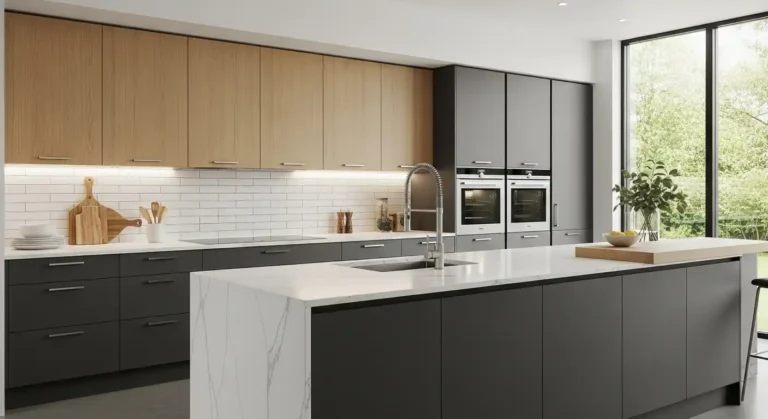
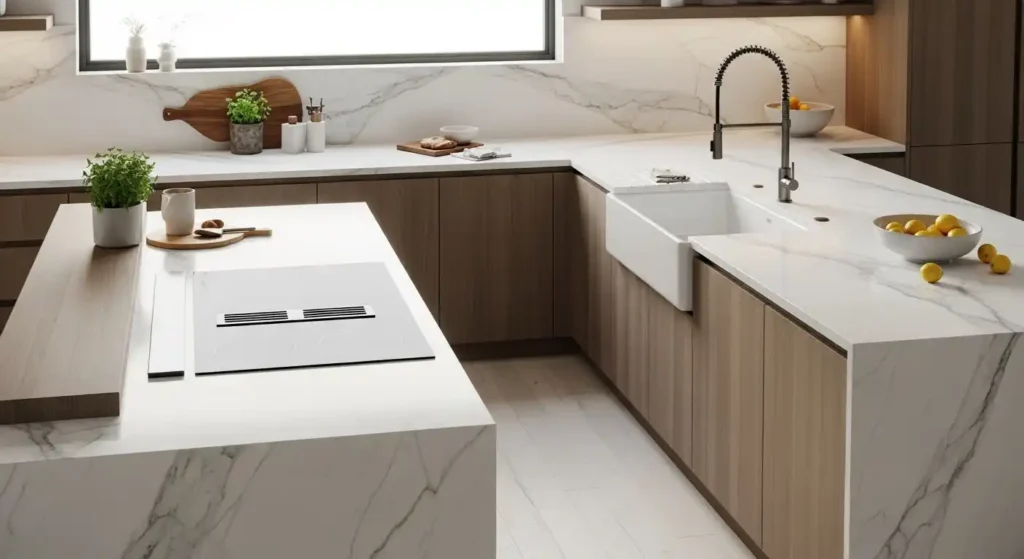
Standard porcelain slabs are thin. If you want the look of a thick, 2-inch marble slab, your fabricator must perform a “mitered edge.”
This involves cutting the edges at a 45-degree angle and joining them perfectly so the pattern continues down the side.
This is a labor-intensive process that requires a master craftsman, and it can significantly increase the total cost.
Cutouts and Finishes
Every hole cut into the slab—for an under-mount sink, a cooktop, or a soap dispenser—adds to the labor.
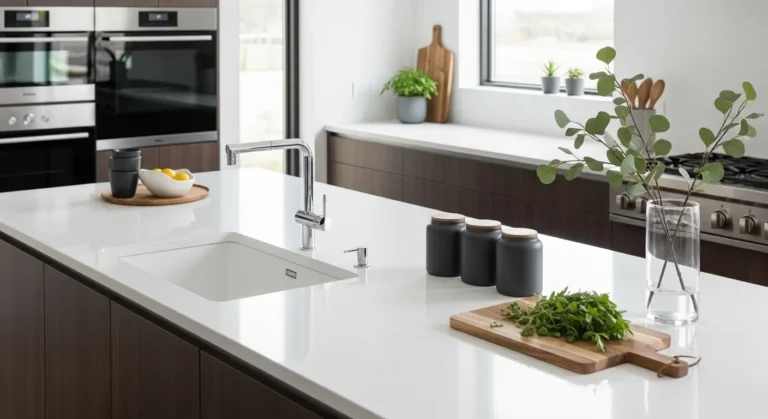
Integrated porcelain sinks, where the sink is made of the same material as the counter for a seamless look, are stunning but are among the most expensive additions you can choose.
Slab Thickness
Porcelain comes in various thicknesses. While 6mm is common for wall cladding or backsplashes, 12mm or 20mm is preferred for countertops.
Naturally, the thicker the slab, the higher the material cost, though thicker slabs may sometimes be easier (and thus cheaper) to fabricate because they are slightly less fragile during handling.
Comparing Porcelain to Other Materials
To truly answer the question, “Are porcelain countertops expensive?” we have to look at the competition.
Porcelain vs. Quartz:
Quartz is often the closest competitor. While the material costs are similar, quartz is much easier to cut and install.
Therefore, a quartz countertop will often be 10% to 20% cheaper than porcelain in total installed cost. However, quartz cannot be used outdoors and is not heat-proof.
Porcelain vs. Granite:
Entry-level granite is almost always cheaper than porcelain.
However, if you are looking at “Level 3” or exotic granites with unique veining, porcelain becomes the more affordable option while offering better stain resistance.
Porcelain vs. Marble:
Porcelain is the clear winner here. It can perfectly mimic the look of the world’s most expensive marbles for a fraction of the price, and unlike marble, it won’t stain if you spill a glass of red wine or etch if you drop a slice of lemon.
The Long-Term Value: Is It Worth the Price?
When evaluating how expensive are porcelain countertops, you shouldn’t just look at the upfront cost. You also need to consider the “cost of ownership” over ten or twenty years.
- Zero Sealing Costs: Unlike granite or marble, which require professional sealing every 1–3 years, porcelain is non-porous. You will never spend a dime on sealants.
- Durability: Porcelain is nearly impossible to scratch and is completely heat-proof. You won’t have to worry about the cost of repairing a scorched resin mark (common in quartz) or a deep scratch.
- Outdoor Longevity: If you are using porcelain for an outdoor kitchen, it is one of the only materials that won’t fade in the sun. Replacing a faded quartz counter in five years is much more expensive than installing porcelain once.
- Resale Value: Porcelain is currently a “trendy” and high-end material. Installing it can increase the perceived value of your home, potentially offering a better return on investment (ROI) than cheaper materials like laminate or tile.
How to Save Money on Porcelain Countertops
If you have fallen in love with porcelain but are worried about the budget, there are ways to bring the price down:
- Choose an Eased Edge: Instead of a complex mitered edge to make the slab look thick, embrace the modern, thin profile of the slab with a simple eased edge.
- Use Remnants: If you are doing a small bathroom vanity or a laundry room, ask your fabricator if they have any porcelain remnants. You can often get the material for a fraction of the price of a full slab.
- Standard Sink Cutouts: Opt for a standard drop-in or under-mount sink rather than a custom-fabricated porcelain farmhouse sink.
- Shop Around for Fabricators: Not all fabricators are comfortable with porcelain. Those who specialize in it often have better equipment and more efficient processes, which can sometimes lead to more competitive labor pricing.
Conclusion
So, are porcelain countertops expensive? Yes, they are a premium product that carries a higher price tag than many traditional materials.
The combination of specialized fabrication and the need for expert installation means you will likely pay more than you would for standard granite or quartz.
However, when you weigh that initial cost against the benefits—total heat resistance, zero maintenance, and the ability to have a “marble” kitchen that is virtually indestructible—the value proposition becomes clear.
For many homeowners, the peace of mind and the high-end aesthetic make porcelain a wise investment that pays for itself in durability and style.
If you want a countertop that looks like a million dollars but performs like industrial equipment, porcelain is well worth the expense.