
When choosing a countertop material, homeowners are often caught between the timeless beauty of natural stone and the modern convenience of engineered surfaces.
One of the biggest selling points of materials like granite and marble is their organic origin, but that beauty comes with a price: maintenance. Specifically, the need for periodic sealing to prevent stains and bacterial growth.
As porcelain slabs have surged in popularity for kitchens and bathrooms, many people are asking the same critical question: Do porcelain countertops need sealing?
No, porcelain countertops do not require sealing because their non-porous surface is fired at extremely high temperatures, making them naturally impervious to liquids and stains.
Contents
- The Science Behind the Surface: Why Porcelain is Non-Porous
- Comparing Maintenance: Porcelain vs. Natural Stone
- Are There Any Exceptions?
- The Benefits of a No-Seal Surface
- How to Clean Porcelain (Since You Don’t Have to Seal It)
- Common Myths About Porcelain Sealing
- The Verdict: A Maintenance-Free Investment
The Science Behind the Surface: Why Porcelain is Non-Porous
To understand why the answer to “Do porcelain countertops need sealing?” is a firm no, we have to look at how these slabs are manufactured.
Porcelain is made from a specific blend of natural minerals, primarily kaolin clay, feldspar, and silica. This mixture is subjected to two extreme processes:
- High Pressure: The raw materials are pressed into slabs using thousands of tons of pressure, removing air pockets and increasing density.
- Vitrification: The slabs are fired in a kiln at temperatures exceeding 2,500°F (1,400°C).
At these extreme temperatures, the minerals melt and fuse together into a solid, glass-like state. This process is called vitrification.
It results in a material that is incredibly dense and has a water absorption rate of less than 0.5%. Because the surface is so compact at a molecular level, there are no microscopic pores for liquids, oils, or bacteria to seep into.
In contrast, natural stones like granite are formed over millions of years with natural fissures and pores.
If you pour red wine on unsealed granite, the stone “drinks” the liquid, leading to a permanent stain. Porcelain simply holds the liquid on the surface until you wipe it away.
Comparing Maintenance: Porcelain vs. Natural Stone
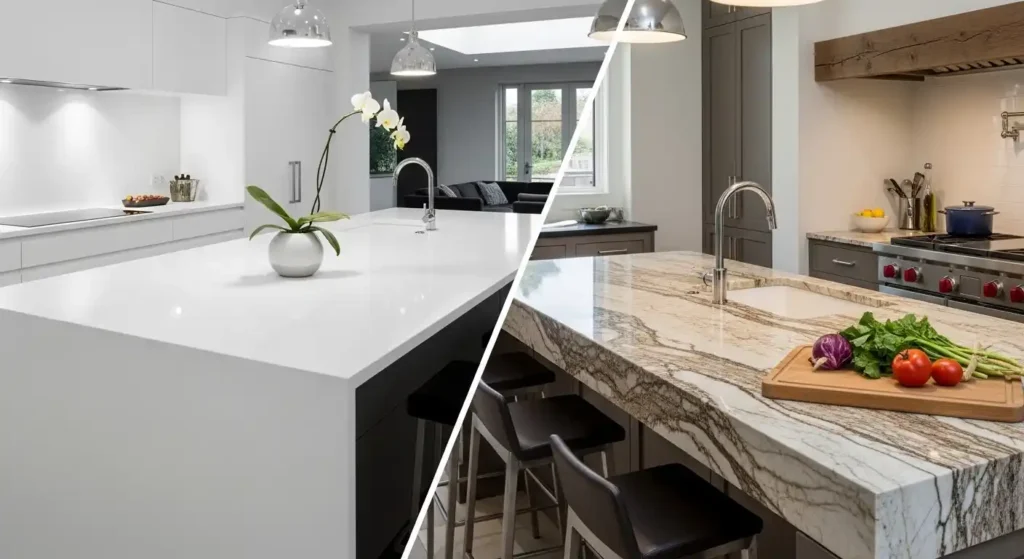
The question of whether do porcelain countertops need sealing is often the deciding factor for busy families who want a “set it and forget it” kitchen.
Let’s look at how porcelain compares to materials that do require sealing.
1. Granite and Quartzite
Granite is the most common natural stone used in kitchens. While durable, it is naturally porous.
Most granite countertops need to be professionally sealed upon installation and then re-sealed every one to three years.
If the sealant wears off, the stone becomes vulnerable to oil and water damage. Porcelain eliminates this entire maintenance cycle.
2. Marble
Marble is even more porous and chemically sensitive than granite.
Not only does it need frequent sealing, but it is also prone to “etching”—a chemical reaction where acidic liquids like lemon juice eat away at the stone.
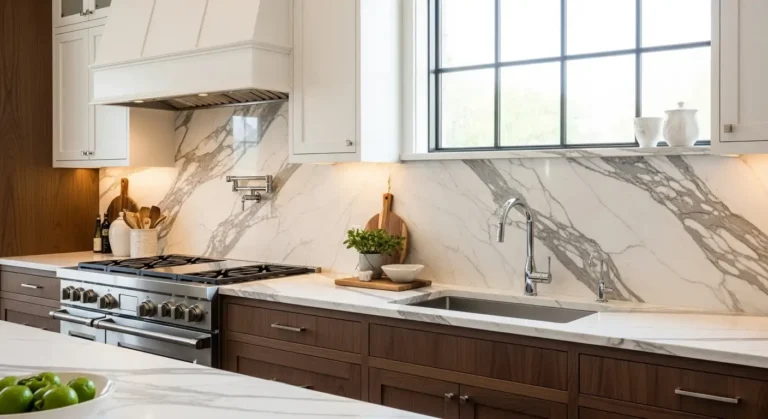
Porcelain can perfectly mimic the look of Carrara or Calacatta marble but requires zero sealing and is immune to acid etching.
3. Quartz
Quartz is porcelain’s closest competitor. Like porcelain, quartz is non-porous and does not need sealing.
However, quartz is bound together with resins (plastics), which can be damaged by heat.
Porcelain offers the non-porous benefits of quartz but with the added bonus of being heat-proof.
Are There Any Exceptions?
While the porcelain material itself never needs sealing, there are two specific scenarios where “sealing” might enter the conversation.
1. Tiled Porcelain Countertops
If you are installing porcelain tiles rather than a large-format slab, you will have grout lines.
While the porcelain tiles themselves are non-porous and do not need sealing, the grout between them is often cement-based and highly porous.
In this case, you must seal the grout lines to prevent them from turning black or absorbing grease.
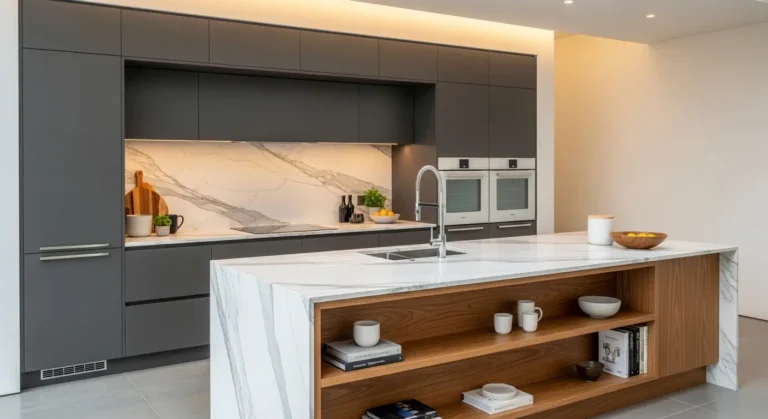
However, most modern porcelain installations use large slabs (up to 10 feet long), which eliminate grout lines entirely.
2. Polished Finishes and “Nano-Coatings”
Some manufacturers of high-gloss, polished porcelain apply a “nano-coating” at the factory.
During the polishing process, the mechanical grinding can occasionally open up microscopic “micropores” on the very surface of the slab.
To ensure a perfect finish, a factory-applied treatment is used to fill these.
While this is technically a form of sealing, it is done during production and does not require the homeowner to perform any periodic re-application.
The Benefits of a No-Seal Surface
The fact that porcelain does not require sealing offers several practical advantages for the modern homeowner.
1. Cost Savings
High-quality stone sealants can be expensive, and hiring a professional to strip and re-seal your counters every few years adds up.
With porcelain, your only “maintenance” cost is the price of a bottle of dish soap and a microfiber cloth.
2. Food Safety and Hygiene
Because porcelain is non-porous and doesn’t need chemical sealants, it is one of the most hygienic surfaces available.
Sealants are chemical products that sit on your counter where you prepare food.
With porcelain, you are working on a pure, mineral-based surface that naturally resists the growth of mold, mildew, and bacteria without the need for chemical barriers.
3. Chemical Resistance
When you seal a natural stone, you have to be very careful about what cleaners you use. Harsh chemicals can “strip” the sealer, leaving the stone exposed.
Because porcelain doesn’t rely on a sealer for protection, you can use much stronger cleaning agents (even bleach or vinegar) without worrying about damaging the surface’s protective layer.
How to Clean Porcelain (Since You Don’t Have to Seal It)
Just because you don’t have to seal porcelain doesn’t mean it’s self-cleaning. However, the process is incredibly simple:
- Daily Cleaning: Use warm water and a mild detergent (like Dawn dish soap). Wipe with a soft cloth.
- Stubborn Messes: For dried food or grease, you can use a non-abrasive cream cleanser.
- What to Avoid: Even though it’s tough, avoid using metal scouring pads or highly abrasive “sandpaper” cleaners, as these can eventually dull the finish of a polished slab over many years.
Common Myths About Porcelain Sealing
Despite the facts, some myths persist in the industry. You might hear a contractor or a salesperson suggest sealing porcelain. Here is why they might be mistaken:
Myth: “All stone needs sealing.” This is a generalization. Porcelain is a ceramic, not a natural stone, and its vitrified structure makes sealing physically impossible—the sealer would simply sit on top and create a hazy, sticky film because it has nowhere to soak in.
Myth: “Dark porcelain stains easier.” Actually, porcelain doesn’t stain at all. If you see a “stain” on dark porcelain, it is usually just a surface residue (like dried soap or hard water minerals) that can be easily cleaned off.
The Verdict: A Maintenance-Free Investment
If you are looking for a countertop that offers the maximum “return on effort,” porcelain is the clear winner.
To revisit our core question: Do porcelain countertops need sealing? No. They are engineered to be impervious to the world around them from the moment they leave the kiln.
By choosing porcelain, you are opting for a surface that combines the high-end aesthetics of natural stone with the industrial-grade durability of a material that never needs to be babied, waxed, or sealed.
For the modern homeowner, that means more time enjoying the kitchen and less time worrying about the next maintenance appointment.
Whether you are dealing with spilled red wine, hot pans, or heavy daily use, porcelain stands up to it all—naturally, and without the need for chemical help.