
Transforming an underutilized basement into a functional living space is one of the smartest moves a homeowner can make.
Whether you are building a guest suite, a rental unit, or a secondary entertainment hub, a basement kitchen adds incredible utility.
However, unlike a standard upstairs kitchen, a basement presents unique challenges—the most significant being airflow.
Because basements are naturally prone to moisture and lack the abundant windows of upper floors, learning how to vent a basement kitchen is not just a matter of comfort; it is a matter of safety and building code compliance.
In this guide, we will explore the best methods for ventilating your lower-level culinary space, the costs involved, and how to ensure your renovation stands the test of time.
Contents
- Why Ventilation is Non-Negotiable in a Basement
- How to Vent a Basement Kitchen: The Primary Methods
- Step-by-Step: Planning Your Basement Venting
- Integrating Ventilation into Your Budget
- Does Proper Venting Increase Home Value?
- Aesthetic Considerations: Hiding the Vents
- Common Pitfalls to Avoid
- Final Thoughts
Why Ventilation is Non-Negotiable in a Basement
When you cook, you release more than just delicious aromas. Steam, grease particles, smoke, and—if you are using gas—carbon monoxide and nitrogen dioxide are all released into the air.
In a standard kitchen, these pollutants might eventually dissipate through windows or high ceilings. In a basement, they become trapped.
Without proper ventilation, the moisture from boiling water can quickly lead to mold and mildew growth in the cool, damp environment of a basement.
Furthermore, lingering grease can settle on your beautiful basement kitchenette design, creating a sticky film that is difficult to clean.
If you want to protect your investment and ensure the air remains breathable, a robust venting strategy is essential.
How to Vent a Basement Kitchen: The Primary Methods

There are two main ways to handle air quality in a basement kitchen: ducted (exterior) venting and ductless (recirculating) venting.
While one is significantly more effective, the other is often chosen for its ease of installation in difficult subterranean spaces.
1. Ducted Ventilation (The Gold Standard)
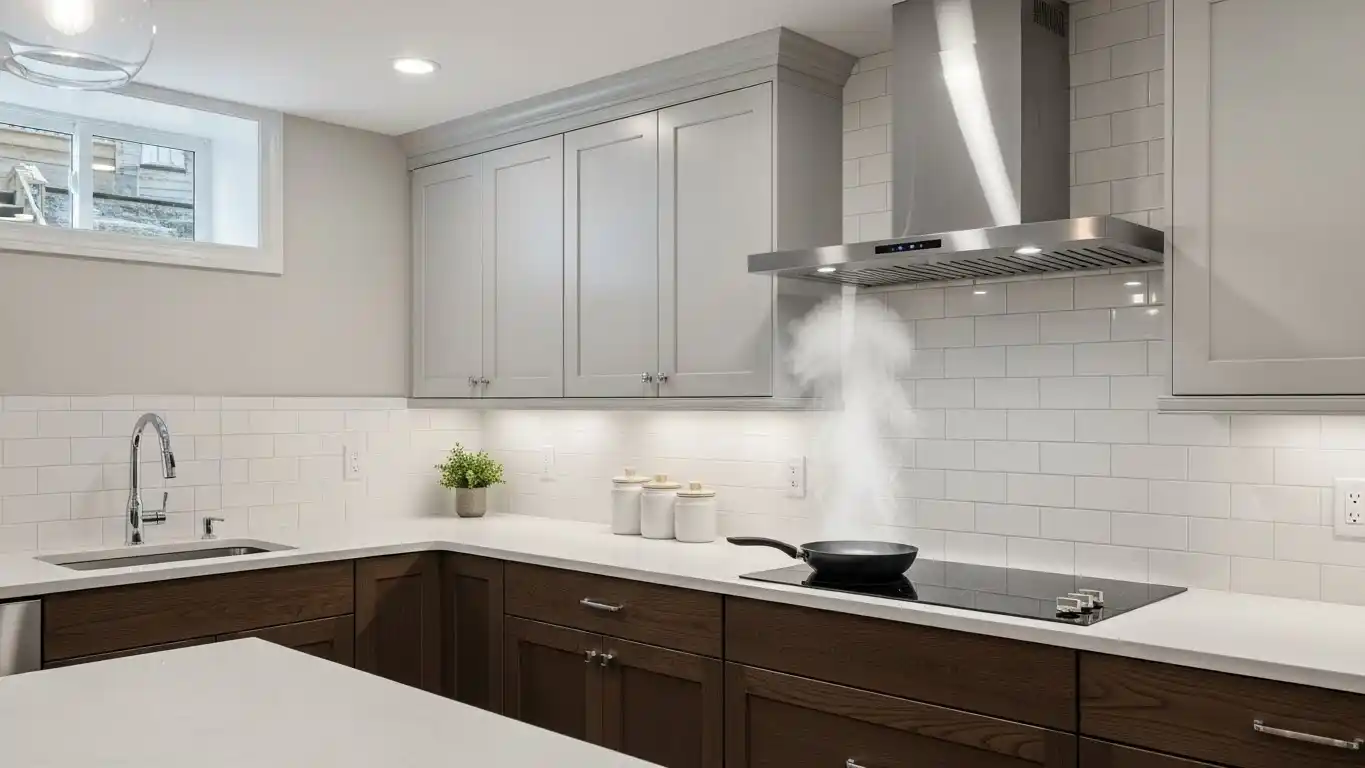
A ducted system pulls air from the kitchen and pushes it completely out of the house through a series of pipes. This is the most effective way to remove heat, moisture, and odors.
In a basement, the challenge is finding a path to the outside. Most contractors will look for the “rim joist”—the area where the basement wall meets the floor of the first story.
By drilling a hole through the rim joist, you can vent the kitchen directly out the side of the house.
If the kitchen is located in the center of the basement, you may need to run ductwork between the ceiling joists to reach an exterior wall.
2. Ductless (Recirculating) Ventilation
If your basement is completely underground or the layout makes exterior ducting impossible, a ductless range hood is an alternative.
These units use charcoal filters to trap grease and odors before blowing the “cleaned” air back into the room.
While easier to install, ductless hoods do not remove heat or moisture.
If you go this route, you must supplement the ventilation with a high-quality dehumidifier to prevent the basement from becoming a swampy environment during heavy cooking.
Step-by-Step: Planning Your Basement Venting

If you are wondering how to vent a basement kitchen effectively, follow these strategic steps:
Assess Your Range Location
The location of your stove or cooktop dictates your venting options. If you are planning a basement kitchenette with island, you will likely need an island range hood.
These can be vented through the ceiling joists to the nearest exterior wall. If the stove is against a wall, a standard wall-mounted hood is much simpler to duct.
Calculate the CFM (Cubic Feet per Minute)
The power of a range hood is measured in CFM. For basement kitchens, you generally want a higher CFM than you might use upstairs because the air is more stagnant.
A good rule of thumb is 100 CFM for every 10 inches of stove width.
However, be mindful of “makeup air” requirements; if your fan is too powerful, it could create a vacuum effect, pulling dangerous combustion gases from your water heater or furnace back into the home.
Choose the Shortest Path
Efficiency is key. Every turn or “elbow” in your ductwork reduces the fan’s effectiveness. Aim for the straightest, shortest path to the outside.
Use smooth metal ducting rather than flexible plastic, as grease can trap easily in the ridges of flexible pipes, creating a fire hazard.
Integrating Ventilation into Your Budget
When calculating the basement kitchenette cost, many homeowners overlook the HVAC and venting requirements.
While a basic recirculating hood might only cost $100 to $200, a fully ducted system installed by a professional can add $500 to $2,000 to your budget, depending on the complexity of the run.
It is important to remember that the average cost to remodel a kitchen often includes these hidden infrastructure needs.
In a basement, the labor cost for a licensed professional to cut through masonry or rim joists is a necessary expense to ensure the job is done safely and remains up to code.
Does Proper Venting Increase Home Value?
You might be asking, “Do basement kitchens add value to a home?” The answer is a resounding yes—but only if they are legal and functional.
A basement kitchen without proper ventilation is a red flag for home inspectors and savvy buyers.
It suggests a “DIY” job that didn’t follow building codes, which can lead to moisture damage and poor air quality.
Conversely, a well-vented, permitted kitchen allows the space to be marketed as a true “in-law suite” or “legal rental unit,” which can significantly boost your property’s market appeal and resale price.
Aesthetic Considerations: Hiding the Vents
One of the biggest hurdles in basement design is the low ceiling height. Running a large 6-inch duct across the ceiling can make a space feel cramped.
To combat this, many designers use “soffits”—boxed-in sections of the ceiling—to hide the ductwork.
If you are worried that these architectural additions will make the room feel dim, you can look for ways on how to brighten a dark kitchen without painting.
Such as adding LED strip lighting along the underside of the soffit or using reflective backsplashes to bounce light around the room.
This ensures that your functional venting doesn’t detract from the beauty of the space.
Common Pitfalls to Avoid
- Venting into the Attic or Crawlspace: Never vent your kitchen into another interior part of the house. This just moves the moisture and grease problem to a different area, where it will eventually cause rot or mold.
- Ignoring Local Codes: Many jurisdictions require a “legal” kitchen to have an exterior vent. Always check with your local building department before starting.
- Forgetting the Backdraft Damper: Ensure your exterior vent cap has a damper. This prevents cold air, insects, and small animals from crawling into your ductwork and entering your kitchen.
Final Thoughts
Learning how to vent a basement kitchen is a critical step in any home renovation project.
While it requires more planning than an upstairs kitchen, the results—clean air, a mold-free environment, and a higher home value—are well worth the effort.
By choosing the right range hood, planning a short and efficient duct path, and ensuring you meet all local safety codes, you can create a basement cooking space that is as healthy as it is beautiful.
Whether you are flipping pancakes on a sleek island or prepping snacks for a movie night, proper ventilation ensures that the only thing lingering in your basement are the good memories.