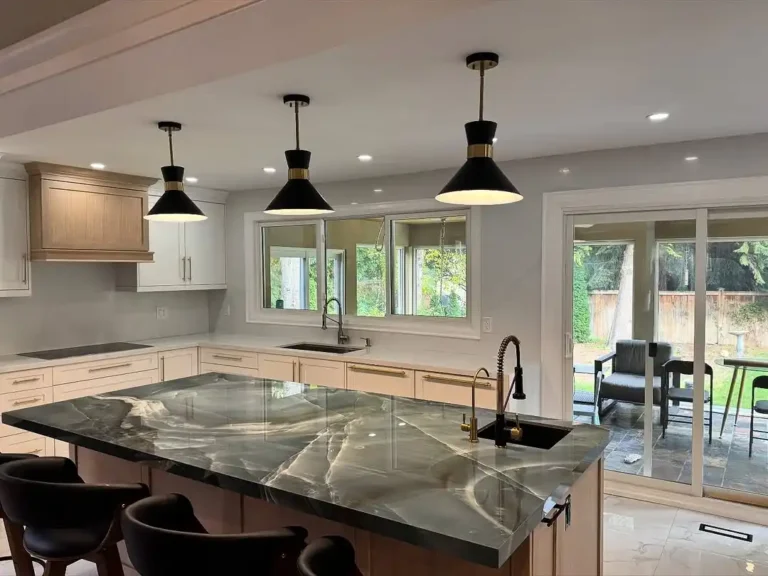

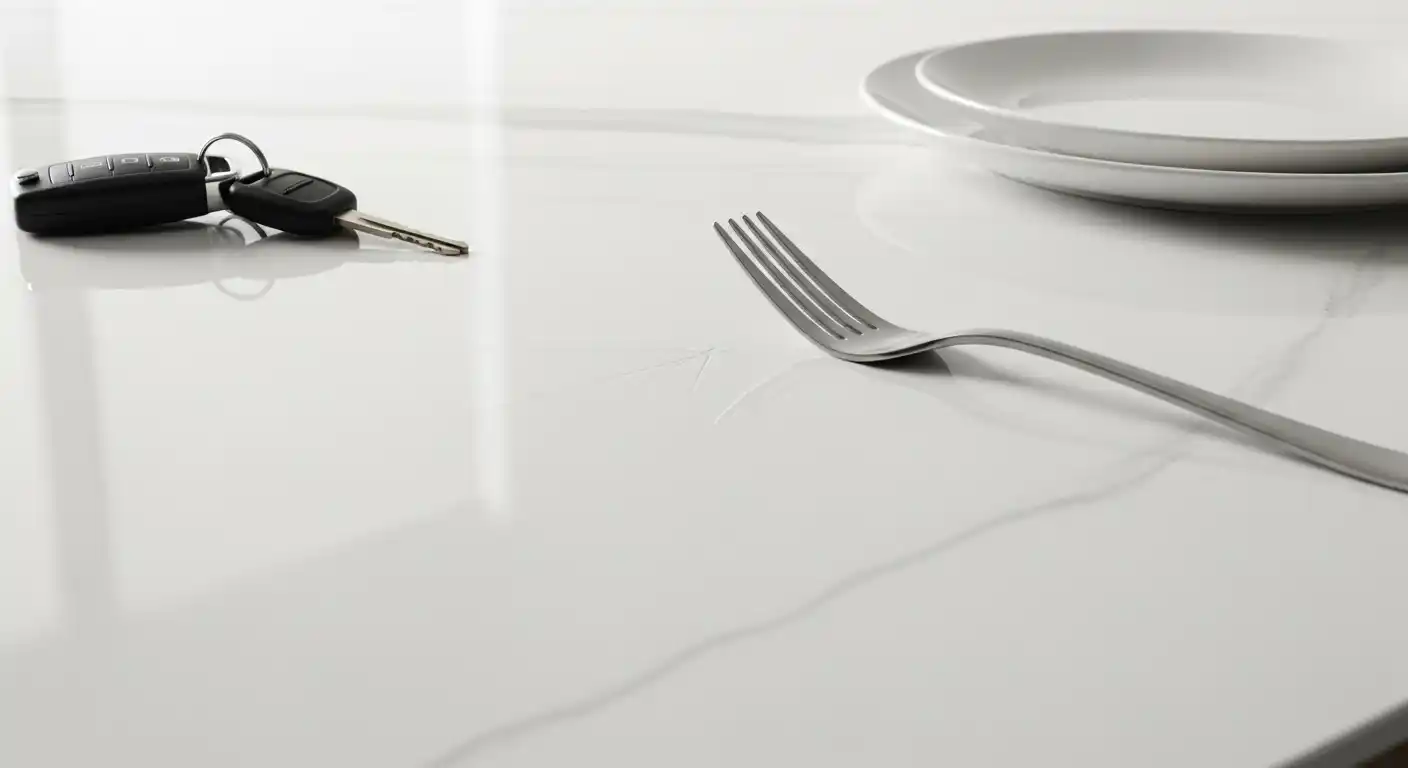
When investing in a kitchen remodel, homeowners are often looking for the “holy grail” of surfaces: a material that looks like luxury marble but performs like industrial steel.
In recent years, porcelain slabs have emerged as a frontrunner in this search. However, before committing to this high-end material, one question stands above the rest for those who actually use their kitchens: Are porcelain countertops scratch resistant?
Porcelain countertops are highly scratch-resistant due to their extreme mineral hardness, which typically ranks between 7 and 8 on the Mohs scale. While they can withstand direct cutting and daily kitchen activity better than most natural stones, they are not entirely “scratch-proof” and can be damaged by ceramic knives or abrasive diamond-edged tools.
But to understand why it is so resilient—and to learn about the few things that can actually damage it—we need to look closer at the science and the daily reality of living with porcelain.
The Science of Hardness: Why Porcelain Wins
To answer the question, “Are porcelain countertops scratch resistant?” we first have to look at how the material is made.
Porcelain is a type of ceramic, but it isn’t the same as the pottery you might find in a craft shop.
It is made from a specific blend of kaolin clay, silica, and feldspar. This mixture is pressed under incredible pressure and then fired in a kiln at temperatures exceeding 2,500°F.
This process, known as vitrification, turns the raw minerals into a glass-like, incredibly dense solid.
On the Mohs Scale of Mineral Hardness—a scale from 1 to 10 used to test the scratch resistance of various minerals—porcelain typically ranks between a 7 and an 8.
To put that into perspective:
- Talcom Powder: 1
- A Copper Penny: 3
- A Typical Kitchen Knife (Stainless Steel): 5 to 5.5
- Granite: 6 to 7
- Quartz: 7
- Porcelain: 7 to 8
- Diamond: 10
Because porcelain is harder than the steel used in your kitchen knives, the knife literally cannot “bite” into the surface to create a scratch.
The Knife Test: Can You Cut Directly on Porcelain?
One of the most common reasons people ask, “Are porcelain countertops scratch resistant?” is because they want to know if they can ditch their cutting boards.
Technically, you can cut directly on a porcelain countertop without scratching the surface. However, most professionals strongly advise against it for two reasons:
It Ruins Your Knives:
Because the porcelain is harder than the knife, the countertop won’t give way, but the edge of your knife will. Cutting on porcelain will dull a high-quality chef’s knife almost instantly.
Metal Transfer:
This is a phenomenon that often confuses homeowners.
Sometimes, after sliding a knife or a heavy pot across the porcelain, you might see a dark grey line that looks exactly like a scratch. In most cases, this is not a scratch.
It is “metal transfer.” Because the porcelain is so hard, it actually acts like a whetstone, grinding off a microscopic layer of the metal onto the surface.
Comparing Scratch Resistance: Porcelain vs. The Competition
To truly appreciate the durability of porcelain, it helps to see how it stacks up against the other “big players” in the countertop world.
Porcelain vs. Quartz
Quartz is often cited as the king of durability, but it has a weakness: resin.
Quartz countertops are made of stone chips held together by plastic resins. While the quartz chips are hard, the resin is not.
Over time, sliding heavy appliances or abrasive items across quartz can lead to “micro-scratching” that dulls the finish.
Porcelain, being 100% mineral-based and fired at high heat, does not have this soft resin component.
Porcelain vs. Granite
Granite is a natural stone and is very hardy. However, granite is porous and composed of various minerals of differing hardness.
Some “soft” spots in a granite slab can be susceptible to scratching over years of heavy use.
Porcelain is uniform and dense throughout, offering a more consistent level of protection across the entire slab.
Porcelain vs. Marble
There is no contest here. Marble is a soft, calcitic stone (ranking about a 3 on the Mohs scale).
It can be scratched by a kitchen knife, a ring, or even the rough bottom of a ceramic mug.
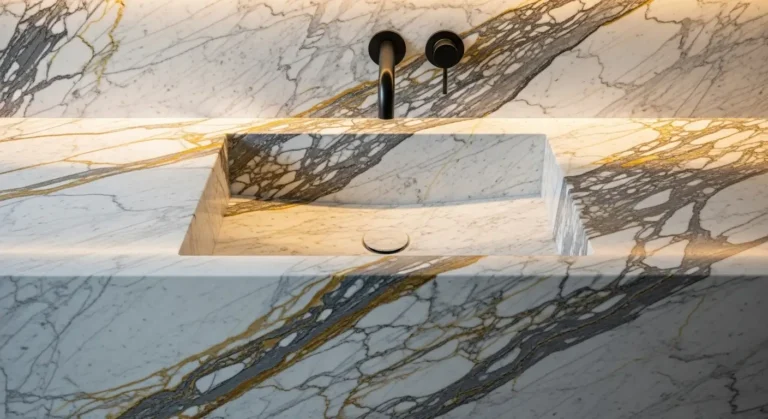
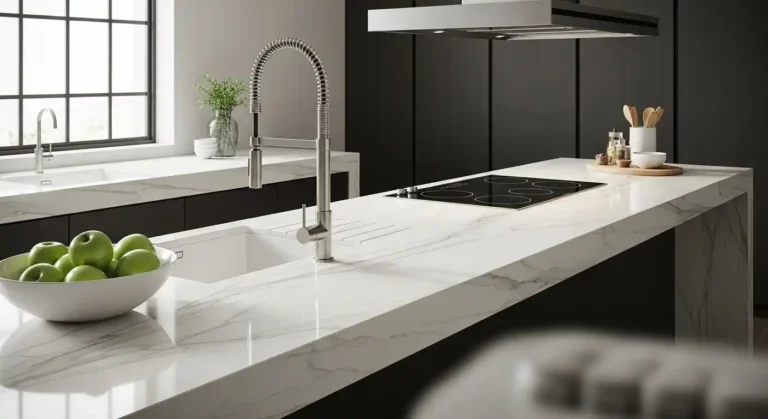
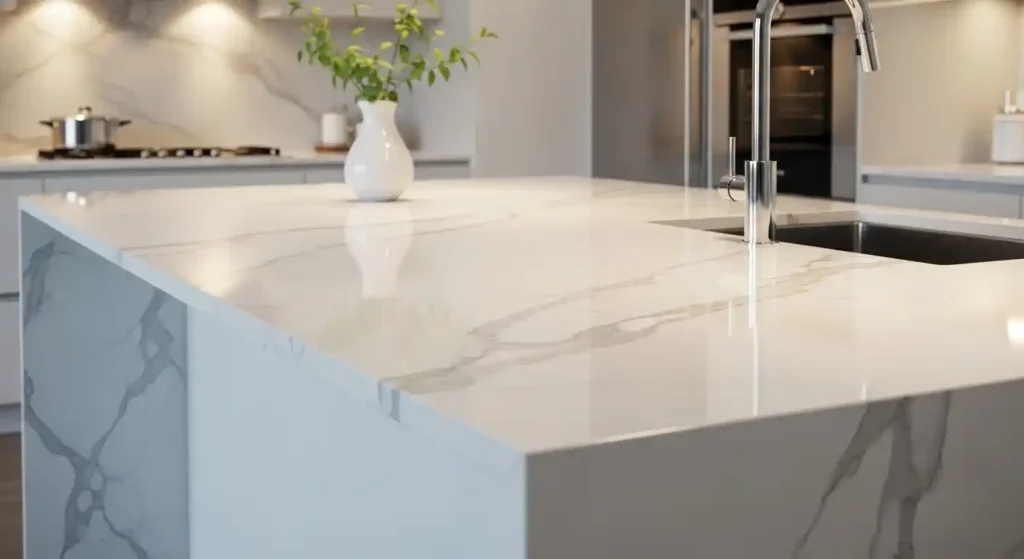
Porcelain can perfectly mimic the look of Carrara or Calacatta marble while providing a surface that is nearly impossible to scratch.
Are There Any Exceptions? What Can Scratch Porcelain?
While we have established that porcelain is incredibly tough, it is not “scratch-proof.” Nothing is. There are a few specific scenarios where you might encounter damage:
- Ceramic-on-Ceramic: The rough, unglazed bottom of a ceramic mug or a stoneware plate can sometimes be as hard as the countertop itself. Sliding these items forcefully across the surface could potentially cause a scratch.
- Diamond Jewelry: Since diamonds rank at a 10 on the Mohs scale, a diamond ring rubbed firmly against a porcelain counter could leave a permanent mark.
- Abrasive Cleaners: While porcelain is chemically resistant, using highly abrasive scouring pads (like industrial steel wool) over a long period could eventually wear down the gloss or “sheen” of a polished porcelain finish.
- Polished vs. Matte Finishes: It is worth noting that polished (high-gloss) porcelain may show “micro-abrasions” more easily than a matte or “honed” finish. If you are extremely concerned about the long-term “new” look of your counters, a matte finish is often the safer bet.
Hardness vs. Brittleness: The Trade-Off
When discussing if are porcelain countertops scratch resistant, it is important to mention the flip side of hardness: brittleness.
In the world of materials, the harder something is, the less it “bends.” While porcelain is nearly impossible to scratch, it is more prone to chipping than quartz or wood.
If you drop a heavy cast-iron skillet on the edge of a porcelain counter, the surface won’t scratch, but the edge might chip or crack.
This is the central irony of porcelain: it is one of the hardest surfaces to scratch, but it requires a bit of care to prevent impact damage.
How to Maintain the Scratch-Free Look
To ensure your porcelain countertops stay looking pristine for decades, follow these simple maintenance tips:
- Use Cutting Boards: Not to protect the counter, but to protect your knives!
- Use Felt Pads: If you have heavy appliances like a stand mixer or a coffee maker that you slide back and forth, put small felt pads on the bottom to prevent metal transfer or accidental scuffs.
- Clean Up Spills Promptly: While porcelain won’t stain, dried-on gunk can require more “elbow grease” to remove. The less you have to scrub with abrasive tools, the better.
- Avoid “Chop-Cutting”: Avoid using heavy cleavers in a way that slams into the counter, as the impact (not the blade) is what poses the risk.
The Verdict
Are porcelain countertops scratch resistant? Absolutely. They are among the most durable surfaces ever engineered for home use.
Their high ranking on the Mohs scale means that everyday kitchen activities—sliding plates, moving pots, and even the occasional accidental slip of a knife—will not leave a mark.
For homeowners who want the beauty of natural stone without the constant anxiety of “etching” or “scratching,” porcelain is an elite choice.
As long as you are mindful of the edges to prevent chipping, a porcelain countertop will likely remain scratch-free for as long as you own your home.
It is a rare material that truly allows you to live in your kitchen rather than just looking at it.